 Mushroom Hunt and Hike 2009 きのこの狩り
The weather was fine for this years Mushroom Hike in Kamakura. Ideally, one more day of warm sunshine after three consecutive days of rain would have helped give the mushrooms a chance to build-up and be easier to spot.天気は何日もの雨の後に非常にすばらしかったです。
 Our first start off point was to ride on the Shonan Monorail one stop to Fujimicho station.
Shonan Monorail is a unique monorail line near Yokohama.
VIDEO:http://www.youtube.com/watch?v=BlHn4g9snQM. The original aim of the line was to demonstrate Sufage-style suspended monorail, but nowadays the line has rather heavy traffic. The train goes through several tunnels and sharp grade, so the ride is shaky. Series 500 and 5000 are currently used. 湘南モノレールは、日本初の本格的な懸垂式モノレールとして1970年に開業しました。建設当時は三菱重工によるサフェージュ式モノレールの試験線という意味合いも強かったのですが、現在では沿線の重要な公共交通機関として用いられています。路線は片側一車線の道路の上単線で建設され、駅には交換設備を持ちます。アップダウンが激しく、路線内にはトンネルもあり、迫力のある乗り心地を楽しむことができます。車両は開業時からの300形・デザインが近代化された400形は引退し、主力の500形とインバータ制御の5000形が用いられています。 We first walked to Kamakura Central Nature park about 30 minutes from the station along the Monorail and up into the hidden part of North Kamakura.
  I like the park because is it secluded (hard to find) それが混雑していないので、私は公園が好きですwhich makes it less crowded than most park in Kamakura, and it has a large turtle pond where you can feed the hungry living rocks piece of stale bread.。多くの亀がいる鯉の池があります。
 We started looking in the Hot Spot areas of the park where I had found mushrooms before. Eventually we found some edible mushrooms. 私たちは公園で多くの場所の中を見ました
 最終的に、私たちはいくつかの美味しいきのこを見つけました! What is good about the woodland mushroom is that they will appear in the same area the following year, and once you find one...there should be more clusters nearby.
ハタケシメジ (キシメジ科、シメジ属)Lyphyllum decastes (Fr.:Fr.) Sing. Woodland mushroom are easily identified by their clusters and hollow stem. The cap is dark brown to black and turns lighter brown when the cap opens up.
 ササクレヒトヨタケ (ヒトヨタケ科、ヒトヨタケ属)Coprinus comatus (Muller : Fr.) Pers. Shaggy Mane, Shaggy dog, called the Hang-nail mushroom because it looks like an unkept dry finger. It is also called an Ink Cap mushroom because it turns black and inky after the cap has been opened. they are best collected when still low to the ground and when the caps color is completely white. The ones we found(pictures) were too old to collect.WARNING: I do not suggest anyone to eat any wild mushrooms unless they consult and expert and are 120% positive on the mushrooms edibility.専門家に尋ねないなら、どんな野生キノコも決して食べないでください。.
 私たちは松茸を料理しました。I bought Matsutake mushrooms from the Farmers Market and grilled them for everyone. I also cooked the Woodland mushrooms in a butter foil steamer for myself.
 After having lunch in a clearing above the east end of the park we took a shortcut through North Kamakura and made our way to Genjiyama Park. 昼食のときに私たちがGenjiyama公園まで歩かせた後
There was also a shrine which let you say your troubles into a small dish and then break the dish on a sacred rock. The dish would shatter and all your worries would vanish....http://www.youtube.com/user/umeboshisensei?feature=mhum
 In the park there is an odd looking tree which I call the "Laughing Tree." '笑っている木'が公園にあります。
 A short walk down the hill from the park is Zeniarai Bentzaiten shrine, or more commonly known as the 'Money washing temple.'. 銭洗弁天(銭洗弁財天宇賀福神社)
Zeniarai Benzaiten Ugafuku Shrine (銭洗弁財天宇賀福神社, Zeniarai Benzaiten Ugafuku Jinja?) is the second most popular spot in Kamakura, Kanagawa prefecture. This beautiful 800-year-old shrine is unusual for a number of reasons, the first being the fact it's completely surrounded by high rock walls. Completely invisible from the outside, it can be reached only thorough a tunnel. Because of the irregular ground it was built on, its various buildings stand at different heights and are connected by stairways.
Those unfamiliar with Japanese history will find Zeniarai Benzaiten confusing. The shrine has literally dozens of torii (Shinto gates), but also plenty of Buddhas. The scent of incense, normally used only by Buddhist temples, is also present. The reason is that Zeniarai Benzaiten is an excellent example of the fusion of Buddhism and Shinto elements (Shinbutsu shūgō) that used to be the norm in Japan before the Meiji era, when most shrines were forced to get rid of all their Buddhist objects. Zeniarai Benten is one of those which, unlike Tsurugaoka Hachiman-gū, were able to retain them.
But what makes it unique, and is also probably the main reason why over 900,000 people a year come here, is that the water of the spring inside Zeniarai Benzaiten's cave is supposed to have the power to multiply the money it comes in contact with. Many people come here specifically to dip their yen in the spring, probably more for fun than greed. Inside the cave where the spring is baskets and ladles are available expressly for that purpose. This unique tradition of coming to wash your coins began in 1257 when Hōjō Tokiyori came here and washed his coins with the spring's water, expressing the hope that they may be doubled. People heard the story, and the tradition was born.(from wiki)
Youtube video http://www.youtube.com/watch?v=FcEmaioKHrk&feature=related I also close a fortune(Omikuji) You shake a large bow and pull out a numbered stick. The temple priest hands you a prayer according to the number on the stick. There are different degrees of luck. Daikichi, is the best. I picked a middle-to-low luck prayer, but I preferred to have low luck- cause that means I have only to go up, whilst a BEST luck means I would have no where else to go but down.
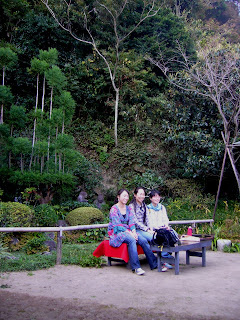
  After having our fortunes told at the temple is was time for a tea break. Every year I ask a friend of mine to let us have tea in the garden of her restaurant.

Mushroom collecting can be done very inexpensively with minimal equipment. You may already have most of the items necessary. However, there are some things you may want or need should you become more serious about your collecting. Below is a list of some carefully selected items a well prepared collector may want while still traveling light.
Vest or backpack A vest such as a fishing or photographers vest is excellent for carrying items listed below. A good backpack with compartments is also useful but somewhat less convenient.
Field guide National Audubon Society Field Guide to North American Mushrooms (National Audubon Society Field Guide Series) by Gary H. Lincoff is highly recommended. Books by Roger Phillips and Miller & Miller are also quite good but not pocketable.
Notebook and pen Taking notes on your finds is very useful. A GPS may be an even better solution.
A magnifying glass is a needed item in many cases and is practically a requirement. I carry a 10x folding loupe in my pocket at all times. They need not be expensive. Everybody has a magnifying lens kicking around the house somewhere.
Basket, mesh bag, or other bags Get a good basket. You may need more than one. There are many good, inexpensive choices. I keep a bag in my back pocket almost always during the season. Paper grocery bags are good, easy to carry and free. Plastic is fine if you transfer your finds to another container like a basket very shortly. Leaving them in a plastic bag for too long on a warm or hot day causes the mushrooms to sweat becoming soft and slimy. A mesh bag is easy to carry. It breathes. It may distribute spores. The mesh can rough up delicate species though. What you need for a container does depend on what you are collecting. A plastic bag is excellent for chaga. None of these solutions may work for a giant sized maitake or chicken of the woods. I use a large, shallow plastic tub for the extra large species. Sometimes that is too small. You may spot mushrooms when you are not "collecting" but just doing your daily business and you don't have all your equipment handy. I try to keep a basket, bags, and some equipment in my vehicle just in case. Often when I hunt it is a process of driving to a place and getting out to harvest for just a few minutes and moving on. Quick collections and transfers to other containers are often the order of the day. A hot car can be a problem with any container that has poor aeration.
Wax or brown paper bags Keeping mushroom species you are not sure about separate is imperative. Unidentified species that are potentially poisonous should not contact your known edibles. You can segregate unknown species in brown paper lunch bags or wax paper bags. Both types are usually available in supermarkets .
Knife A mushroom knife is useful for the purpose but often a bit expensive. A mushroom knife usually has a brush on one end for brushing off your finds. They can be a hard item to find but there always seem to be a few on eBay. As a knife collector, I sort of cringe when I see most of the offerings. They look cheapo to me. A pruning knife or other knife that is sharp is fine. I always have a Swiss Army Knife in my pocket. You may want to bring a mushroom brush or small paintbrush if you choose a conventional knife. I may try using the LED flashlight in this knife in making photographs. Knives tend to dull quickly when coming in to incidental contact with the ground. Sharpening in the field is often not practical. Once they get dull they tend to pull the whole stem out of the ground.
In some cases, it is best to pull up the whole mushroom rather than cut it. You could need the whole stem for study or the stem butts for propagation. I like to bury the stem butts in my woods. It is verboten to cut a matsutake for the Japanese market. They will only buy them untrimmed.
Utility scissors Inexpensive utility scissors can be very useful for collecting. I like scissors for chanterelles which tend to pull out of the ground when using a dull knife.
Garden trowel A garden trowel is a useful thing to have if transplantation interests you or you want some mycelium for further study.
Hatchet A small hatchet is usually necessary for harvesting chaga (Inonotus obliquus).
GPS with WAAS and maps This is an optional item that can give a sense of security about not getting lost in the woods if you want to follow the mushrooms where you find them. WAAS units are accurate within 3 meters. Built in maps make navigating easy by saving track logs, waypoints and more. I start by marking the location of my vehicle before entering the woods. You can mark locations of your best finds exactly adding any pertinent text information you may need. I bought a Megellan Explorist 200 for a bit over $100. Maps and memory are self contained. More expensive GPS units may have removable memory cards or attach to your computer's USB port for information exchange.
Bug repellant and hat. Not having these items can ruin your day. The black flies, mosquitoes, and deer flies really like dive-bombing my bald spot and thoroughly enjoy watching me slap myself in the head. I hear them laughing. I see the humor but eventually I slap some sense into myself and get my hat and repellant. I usually spray the repellant on my hat and sometimes my socks rather than my skin. I use Deep Woods Off!
Water. Bring a canteen of water or other refreshment.
Footwear, gloves, etc. Gloves can be necessary when the chanterelles are in or around the poison ivy. Digging around in the dirt can bring you in contact with poison ivy roots. Gloves make handling possibly poisonous species safer.
Good shoes or boots should be worn for protection and comfort. In the places I frequent in Maine I need waterproof boots. Tall socks you can tuck your pant legs into are best during black fly and No see um season. It helps prevent the deer ticks that are so common in Maine from getting on your skin. Deer ticks are the main carrier Lyme disease and other diseases and are one of the biggest dangers mushroom collectors face. I do a tick check when I get out of the woods and often find them. A deer tick will often crawl around on your skin for 12-24 hours before deciding where to bite.
A whistle is good to have so someone can find you if you are lost or injured. It's wise to bring a cell phone
Further info can be found on these sites:


 (not long enough to freeze, just long enough to become firm)Grind the meat and fat together twice, using a coarse blade and meat mincer. 肉挽き機3で豚肉肉とミックスを切ります: 1の部品
 up a small portion to taste
 close. 豚肉肉でソーセージケーシングをゆっくり満たしてください、そして、終わりを摘み取ってください。

 Thank you all for coming.
 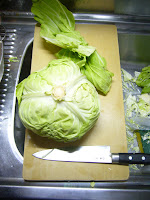 Fresh sauerkraut contains lactobacilli, beneficial bacteria that improve the functioning of the digestive tract. Probiotic foods such as sauerkraut and yogurt are often recommended for people taking antibiotics, which kill both the beneficial and harmful bacteria in the body. Live-culture foods can help restore the beneficial bacteria.
 Sprinkle half the salt over the cabbage. Grate the second cabbage, then add it to the crock along with the rest of the salt. Crush the mixture with your hands until liquid comes out of the cabbage freely. Place a plate on top of the cabbage, then a weight on top of the plate.
  Cover the container and check after 2 days. Scoop the scum off the top, repack and check every 3 days. After 2 weeks, sample the kraut to see if it tastes ready to eat. The flavor will continue to mature for the next several weeks. Canning or refrigerating the sauerkraut will extend its shelf life. Yields about 2 quarts.
 You are first given a questionaire from a faceless waitress who asks you to fill out the form and call her when you've complete it. The basic questions are 1. How would you like you noodles cooked? 2. What type of broth would you prefer? 3. Would you like your ramen mild or spicy or super hot?
 After a bit, the waitress brings your meal and says please enjoy, then she closes the shutters and you are left alone to contemplate your exsistence with the steaming bowl of ramen. Should you finish off the noodle in no time flat, you can request a second helping by calling the waitress back with a call button located at the top of the counter next to the water fountain.
 After you've finished your noodles you simple say "Gochiso-sama" and leave the counter. I felt so lonely and helpless eating alone in a closed ramen shop, but I might go again, just to keep myself company.....
